
Why Execution Quality Is an Architecture Problem
Onchain money markets now move serious size with stablecoins as the main vehicle. But execution quality still depends too much on where a trade starts, which chain it lands on, and how fragmented local liquidity is at that moment.
That is a market structure problem.
At Superset, we built our architecture around one objective: make pricing and execution behavior more consistent across onchain environments.
This article explains how that works in practice.
It focuses on four questions:
- What is the real bottleneck in onchain money execution?
- How do virtual pools and a hub-and-spoke design address that bottleneck?
- What changes in day-to-day outcomes for users, integrators, and liquidity participants?
- Why does this matter now?
Why architecture sets execution quality
Most onchain execution discussions start from routing. Find more pools, scan more paths, combine more hops. If liquidity sits in isolated pockets, the router only optimizes within the pockets it can reach at that moment. The ceiling is still set by architecture.
Execution quality is the operating result of three things:
- Pricing consistency: similar trades should not produce wildly different outcomes because they originated in different pockets.
- Completion reliability: when conditions fail, users should get deterministic handling.
- Size handling: larger orders should not collapse into poor fills only because depth is split.
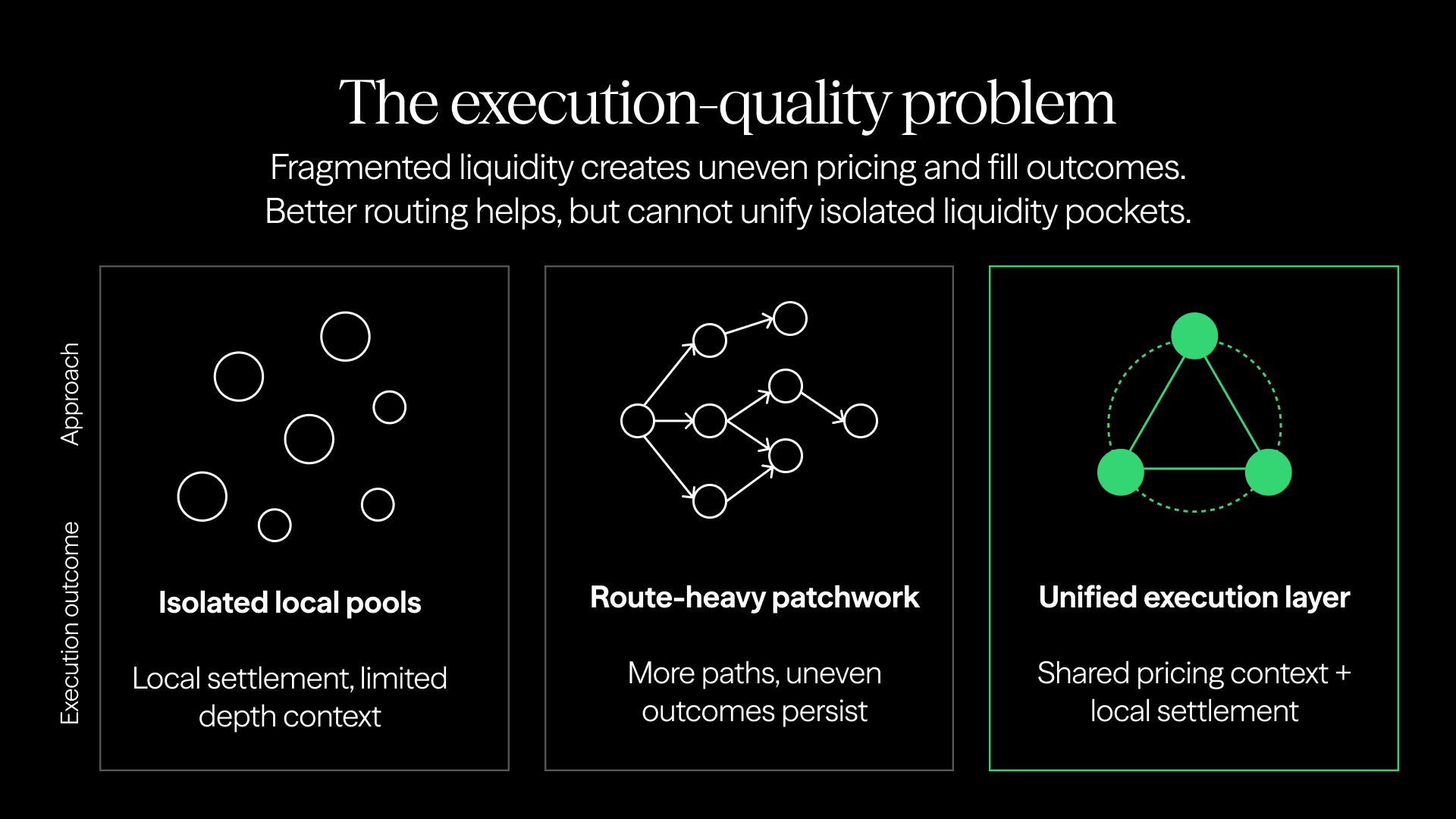
In fragmented systems, a market can show strong headline liquidity while real execution still feels uneven. Two users making similar swaps can see different behavior depending on pool composition on that chain, temporary imbalances in local vault balances, and path complexity.
This is why Superset treats execution quality as a systems question first, then a routing question.
If the bottleneck is architectural, the next step is to define what the architecture is supposed to optimize.
The execution-quality objective
The design objective looks like this:
- Coordinate pricing at a shared market layer.
- Keep settlement local to where users are active.
- Make failure handling explicit and recoverable.
This objective directly shapes Superset’s architecture decisions. We built Superset as a unified execution layer for onchain FX and onchain money flows.
With the objective clear, we can look at architecture in practice.
Architecture in practice: virtual pools & hub-and-spoke
Superset uses a hub-and-spoke model. The hub is the coordination layer. It maintains global liquidity state and runs swap math on virtual pools. Spokes are local interaction points on each chain. Users interact there, and real token balances are held in local vaults.
This hub-and-spoke design is important because it separates decision-making from local execution. Pricing and routing logic can stay consistent at the center, while users still trade in familiar local environments. That reduces the odds that two similar trades receive materially different treatment only because they started on different chains.
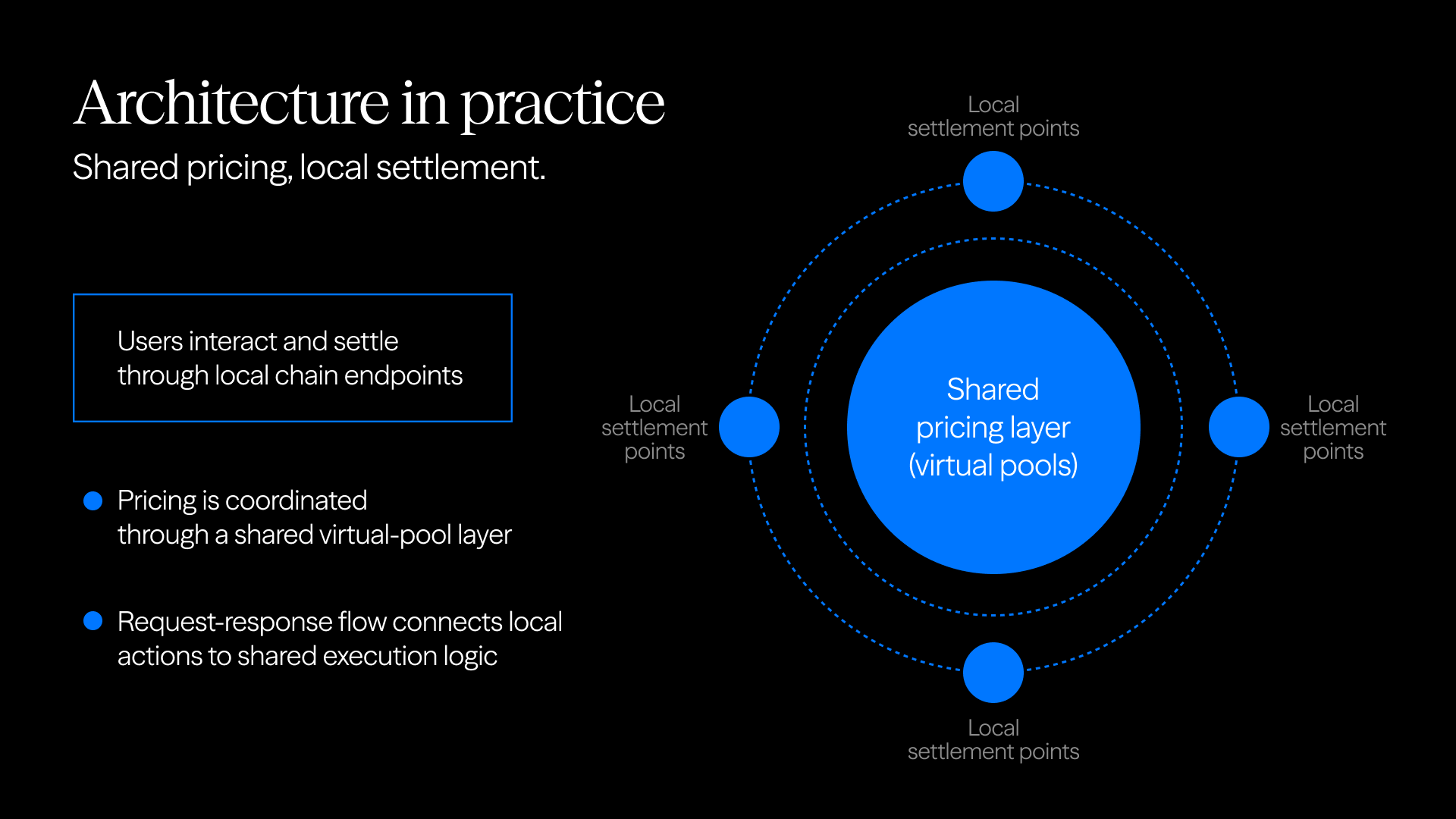
Superset uses a hub-and-spoke model. The hub is the coordination layer. It maintains global liquidity state and runs swap math on virtual pools. Spokes are local interaction points on each chain. Users interact there, and real token balances are held in local vaults.
This hub-and-spoke design is important because it separates decision-making from local execution. Pricing and routing logic can stay consistent at the center, while users still trade in familiar local environments. That reduces the odds that two similar trades receive materially different treatment only because they started on different chains.
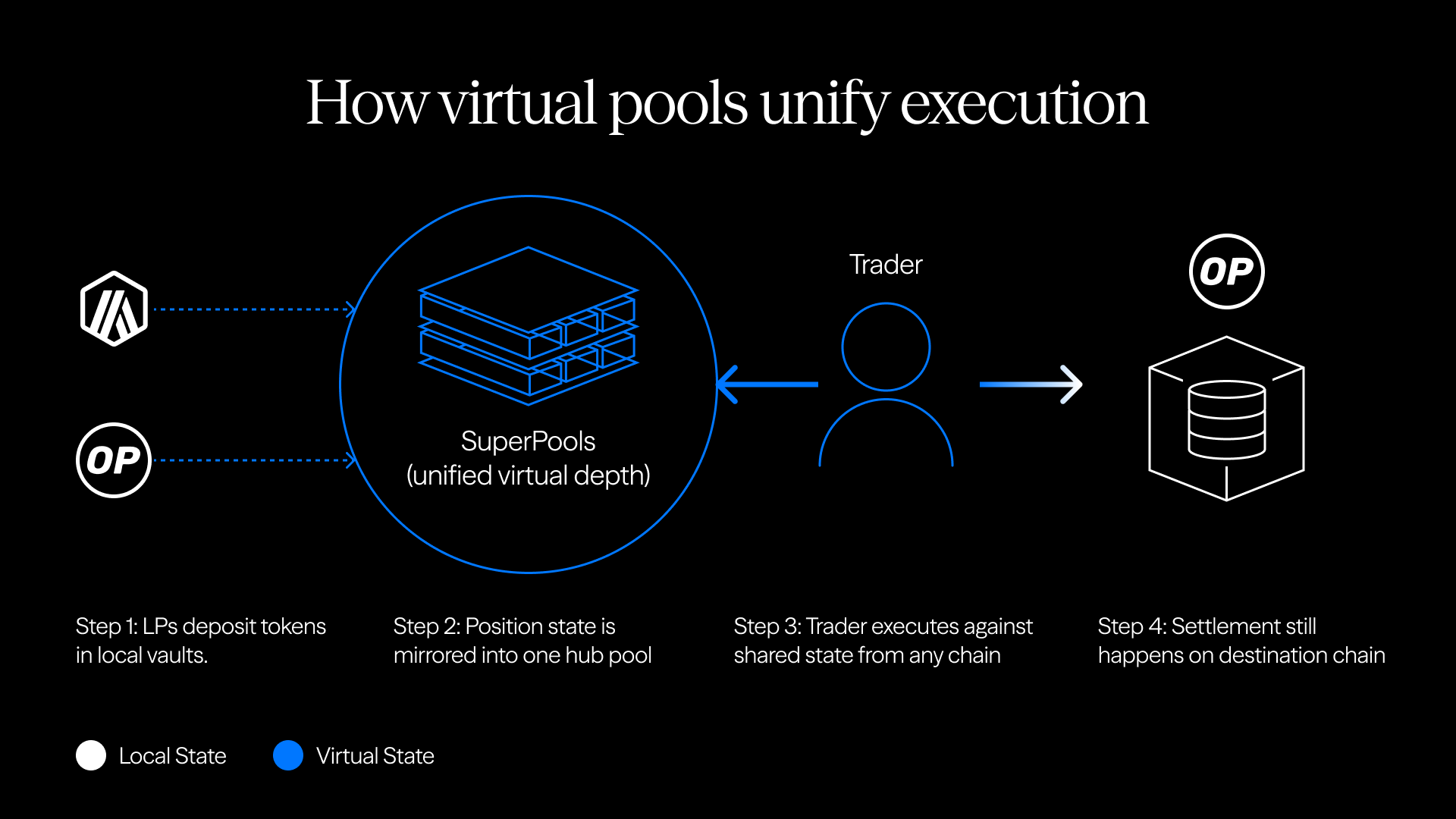
This architecture split is the key:
- Shared pricing context at the hub.
- Local token delivery and custody at spokes.
That is how Superset can expose broader depth for pricing while keeping chain-local user interaction and settlement behavior.
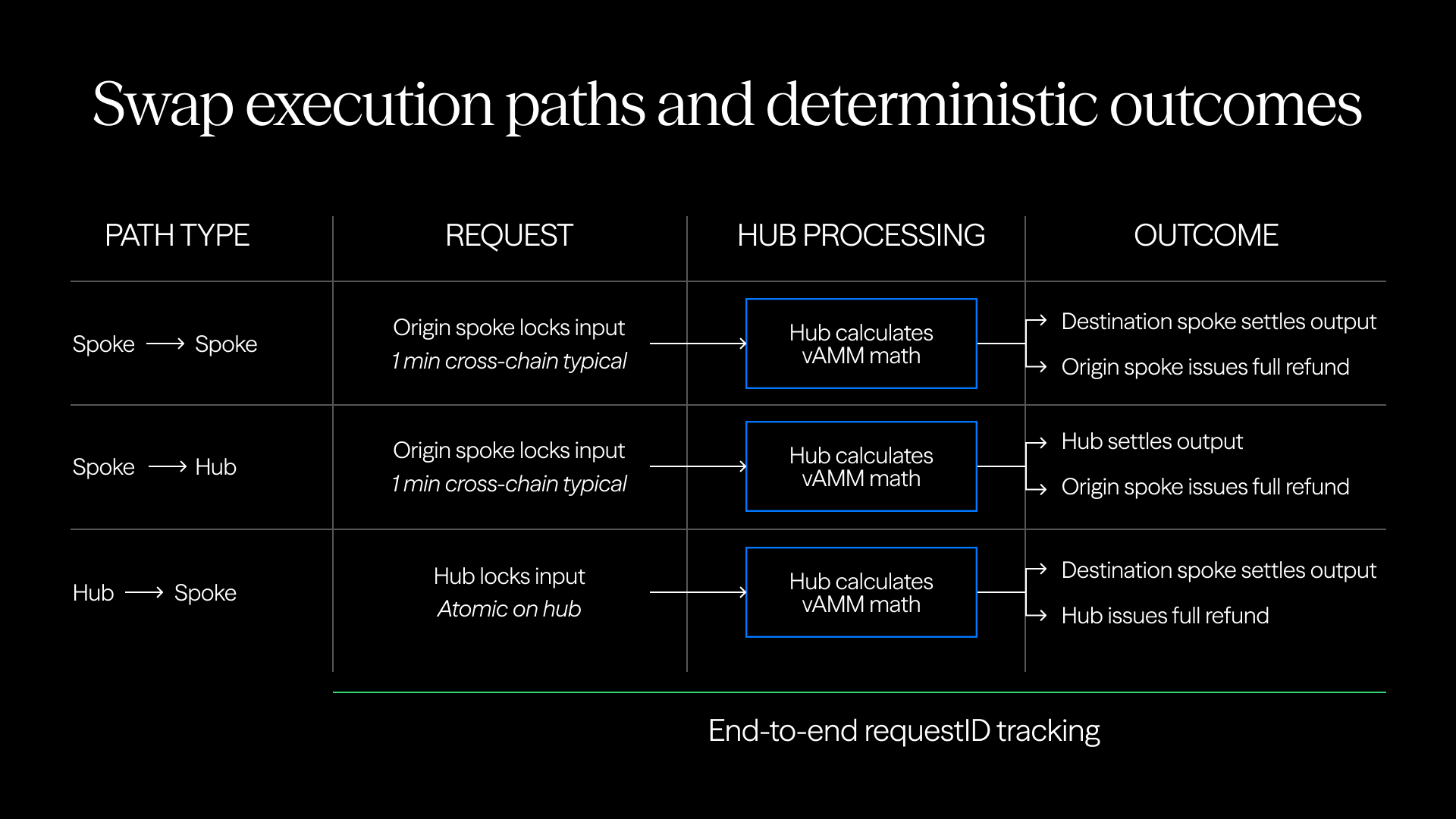
A spoke-initiated swap follows a predictable flow:
- A user submits a swap request on a spoke chain.
- The request is forwarded to the hub for pricing and execution logic.
- The hub processes the swap against virtual pool state.
- The hub sends back a success or failure response with the same request identifier.
- The spoke either settles output tokens locally or returns the user’s input according to protocol failure rules.
The sequence matters beyond architecture clarity. It gives users and integrators a stable operating model.
Two execution scenarios show the difference between fragmented execution and Superset architecture.
Example 1: virtual-pool pricing with local settlement
Without a shared execution layer, pricing depends on local pool depth, so similar trades can produce different outcomes across chains. With Superset, a trade on one chain can price against a shared virtual-pool context of $3M while still settling from that chain’s local vault.
Takeaway: pricing can reflect crosschain combined depth, while settlement remains local.
Example 2: local vault depth is not trapped per pool
Without consolidated local vaulting, liquidity is effectively pool-bound, so each pool can become thin on its own. With Superset, if three same chain pools use USDT0 and the chain holds $1.5M USDT0 in local settlement inventory, a swap in one pool can draw from that shared local balance.
Takeaway: local effective depth is consolidated at the vault level instead of being trapped inside per-pool silos.
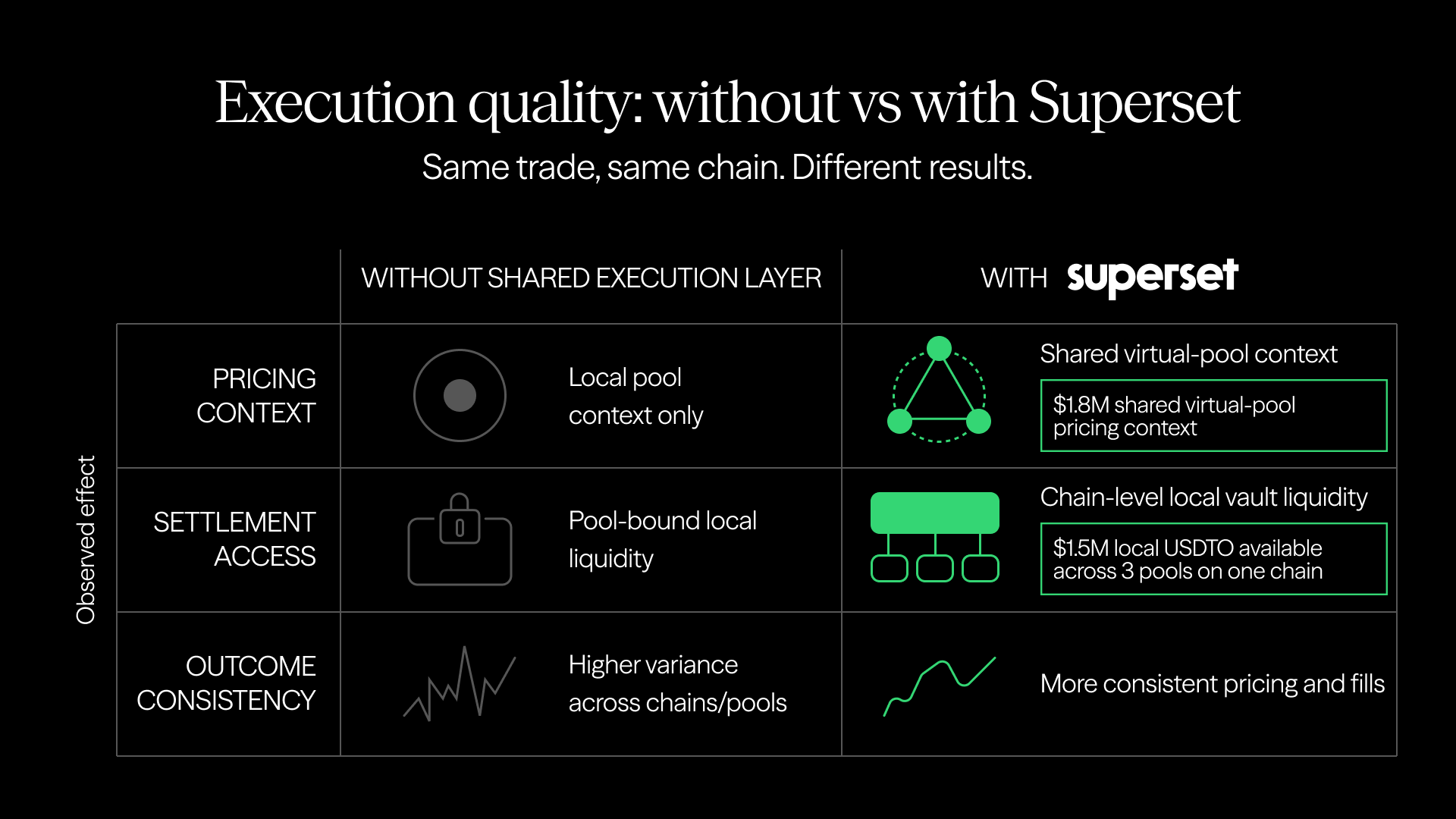
These examples make the mechanism visible in practice. Shared pricing plus local consolidated settlement depth improves how execution is experienced.
But architecture only matters if it changes outcomes for real participants.
Outcomes: what changes for users, integrators, and market participants
This is where architecture turns into day-to-day outcomes for users, liquidity participants and other integrators.
For users and traders
Virtual pools price against combined liquidity state instead of a single isolated local pool. Users still receive tokens through local spoke vault flows, including same-chain output or crosschain output routes.
Swap execution includes explicit failure checks, including insufficient output-side vault balance, slippage floor not met, deadline expired, and gas-exhaustion protection. In these failure paths, input tokens are refunded.
This matters because users care about final outcomes, not architecture diagrams. Predictable handling reduces operational uncertainty.
For integrators and apps
Integrators get one request-response framework across single-hop, multi-hop, and crosschain output flows. End-to-end traces use `requestId` across hub and spoke events, which improves reconciliation and support.
They can also choose execution mode based on latency and atomicity needs: spoke-initiated paths for broad chain access, or direct hub execution where atomic behavior is required.
Operationally, this matters most during incidents. Shared identifiers make it easier to trace exactly where a request failed.
For LPs, market makers and other market participants
Liquidity contributes to a unified pricing layer through virtual pool state at the hub. Chain-level settlement support can be targeted through staking and Token Pot mechanics. Single-sided liquidity can also add local settlement capacity without requiring concentrated-liquidity position management.
For market participants, the effect is structural. Liquidity supports execution quality at the system level instead of sitting in isolated local pools.
Superset is designed with liquidity and LPs in mind. More information around incentives will be released in a future piece.
Why this matters now
Stablecoin rails are scaling, institutional chain activity is rising, and multichain fragmentation is not going away. Depth is concentrated in major environments but still distributed across a long tail of smaller chains.
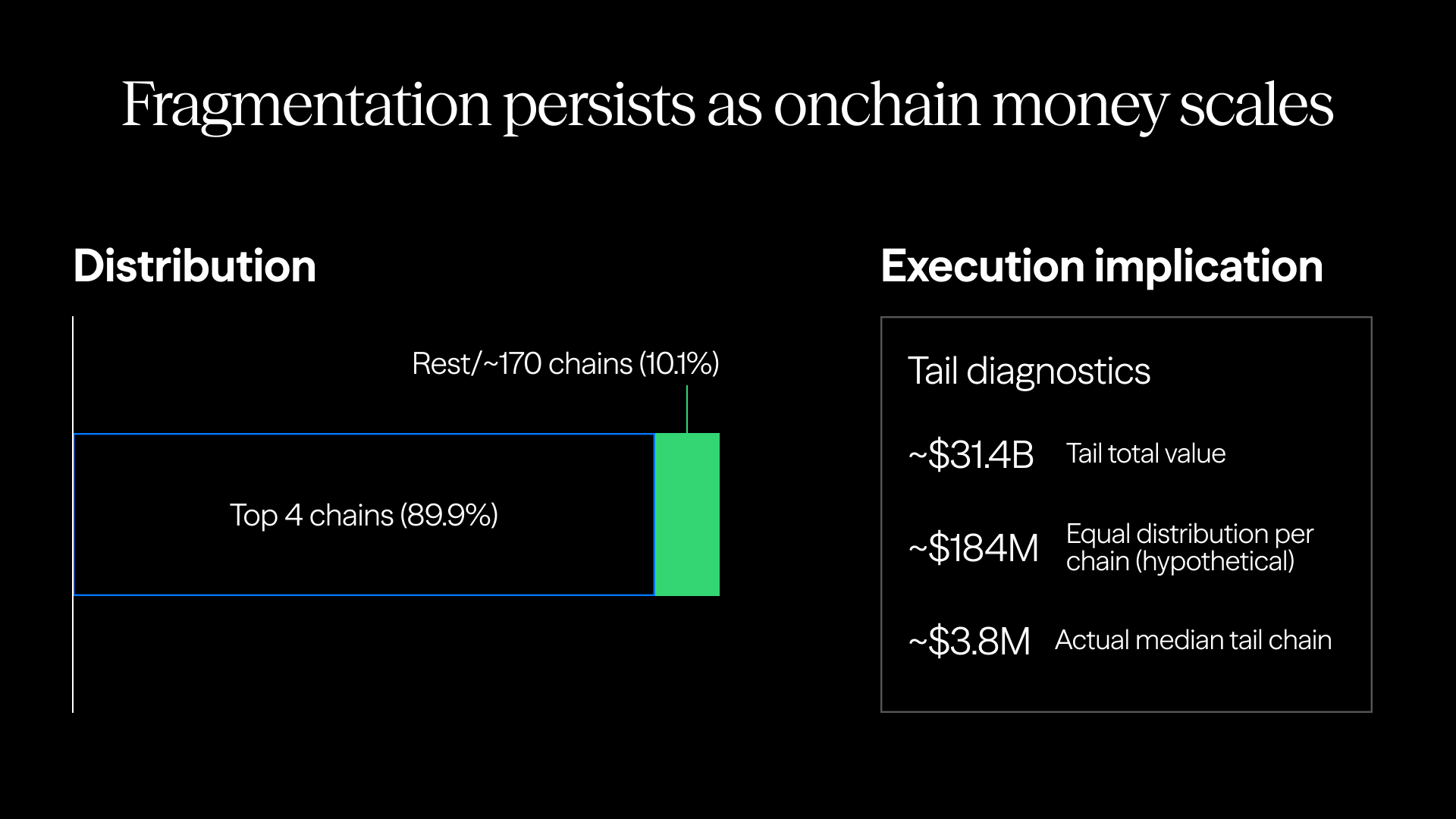
In this segment, liquidity is concentrated in major environments, but still materially distributed across a long tail. Almost 90% of the stablecoin supply is distributed on the top four. The rest is spread across ~170 chains.
After the top four chains, about $31.4B remains spread across roughly 170 other chains. Even in an equal-distribution scenario, that is only ~$184M per chain, which shows how quickly depth thins out across the long tail. Median tail chain is only ~$3.8M, so the tail is highly uneven and thinner than the hypothetical average implies.
That is the environment where architecture quality becomes decision-critical. Participants increasingly operate across multiple chains, while depth and settlement conditions remain uneven by location.
As flow sizes and integration volume increase, execution consistency shifts from preference to requirement. Teams need predictable behavior for routing, settlement, and risk handling under normal and stressed conditions.
Superset’s architecture is built for that requirement.
The market has grown large enough that architecture quality directly shapes user outcomes. Execution layers that coordinate pricing and settlement are becoming core infrastructure for onchain FX and onchain money flows.
Consistent pricing is a systems outcome
Consistent execution quality requires coordinated pricing and explicit settlement paths. Shared liquidity context at the execution layer, paired with local settlement, produces more consistent outcomes across environments.
The purpose of Superset’s architecture:
- Virtual pools for shared pricing context.
- Hub-and-spoke coordination for crosschain execution logic.
- Local vault settlement paths for practical user delivery.
- Explicit failure and response flows for operational predictability.
This is how we approach onchain FX infrastructure as the Unified Execution Layer.